For the board
Live Historic
A house that can still tell what is worth keeping.
Written for the board on October 23, 2026. The questions were put to a room at the CUES Advanced Management Program by Professor Chekitan S. Dev, Professor Drew Pascarella, Bradley N. Treat, and General (Retired) George Casey. The frameworks are theirs. The answers are Live Historic's. Cornell's slides are not copied here. The pictures in this paper are the desk as it stands, so a director who was not in the room can see how the work actually runs. This paper is not an Internal Revenue Service determination. It does not invent a gift we have not received, an employer identification number, or a filing we have not made.
Download the business case1. What we are really trying to accomplish
General Casey will not let a briefing start until two questions have been answered in plain speech. What are we really trying to accomplish? A household that still knows it is one link in a chain, and that treats the evening as part of the duty that comes with the link. What are the most important things we must do? Give that house one number before the story starts, a shelf for each person, and one change it can make this week.
Everything else on the desk is in service of those two sentences. Search, Annie, the films, the share sheet, the join walk, the research page, and this paper itself are tools. If a feature does not help a family keep what is worth handing on, or leave what is not, it does not get built. The same test applies to a partnership, a hire, and a sentence on the site. A larger audience that does not move a Sunday is not the accomplishment.
2. Where the name comes from
Living historically means a house knows it belongs to a chain. The chain runs back before anyone now alive was born, and it runs on after they are gone. A person's turn is seventy or eighty years. In that turn the work is to hold what was inherited and to hand it on in a condition the next generation can carry. The failure is a horizon that shrinks to this afternoon, until a family can think of nothing past the next click.
The line under the name is the standard we set for the desk. Plant what you will never sit under. The people who begin this will not sit through every evening it eventually serves. That is the point of the work, not a reason to leave it unfinished.
An evening is one of the things a house stewards. Most of what a family now inherits in that hour is chosen by a company whose horizon is the next click. The desk exists so the house can choose with a longer one.
3. What we take from the opening of the room
Casey opened with three lines from Alan Murray, written in January 2020. Capitalism is the best system known for organizing an economy, and it should be improved rather than replaced. Globalization is a fact of technical progress, and it should be shaped rather than fought. Leadership will be tested, and it will need wisdom, courage, and a store of moral authority.
We are not a firm, and we are not a treatise on either of the first two sentences. What we take from them is a boundary. We do not propose to replace Netflix, Hulu, Disney+, or Prime Video. We sit in front of them and score the story they deliver. We do not campaign against a catalog because it crossed a border. A story is fit or it is not, wherever it was made. The third sentence is the work. Moral authority here is not a tone of voice. It is a published arithmetic, a record that stays in the house, and a refusal to tell a donor something the law does not yet allow.
4. Purpose is the seat, not a slogan
Professor Dev puts purpose on the seat of a three-legged stool, held up by vision, mission, and values. He also draws it as an iceberg. The public sees the brand. Under the waterline sit strategy, then mission, then vision, then the values that do not move. His line for the week was that people do not lead people. Purpose leads people. A director who cannot say the purpose will improvise one under pressure, and the improvisation will be whatever is easiest that afternoon.
Our purpose, the seat itself, is this. We help a house live historically through the evening it keeps. The three legs are written below so that a person who was not in the room can still sit on the stool. If one leg is vivid and the other two are vague, the stool tips. We would rather be plain in all three than stirring in one.
5. Vision, which is the why
Dev asks for a desired future, short enough to remember, broad enough to aim by, and strict enough to decide with. It is the North Star. It answers why, not how. The visions he put on the screen fell into a few kinds. Some named a duty larger than the institution, as the opening of the United Nations charter does. Some were short enough to survive a hurried meeting, and some of those were empty, because happiness and refreshment can mean anything. Some were boasts about being the first choice. We kept the duty and the shortness, and we threw out the boast. The future we want is not that Live Historic be famous. It is that a house be more able.
The vision is this. A house that can still tell what is worth keeping, and hands the evening on in better shape than it found it.
That sentence rules out a subscription, an advertising business, and any use of a family's record as a product. It also rules out a desk that merely entertains. If a choice does not leave the next evening better than this one, it is the wrong choice, even when it would be easier to fund.
6. Mission, which is the present
A mission says what we do now, how we do it, and the level of performance we owe. Live Historic scores a story from 0 to 100, at no charge, so a family can keep what is fit to inherit and leave what is not.
The how is fixed, and it is already the desk. Eight measures, each from 0 to 10: industry, the household, piety, courage, republic, temperance, truth, and stewardship. Add them, divide by eight, multiply by ten. That is the Living Meter. A person's number is the mean of the titles on that person's shelf. The house number is the mean of the people. A kept evening is a title at 70 or above. Once a week the desk names one title to leave and one to put in its place.
The performance we owe is equally fixed. The number is ready before the play button. The record stays on the device. A child does not get an account. A streaming password is never asked. We do not describe the meter as a diagnosis. We do not describe a gift as deductible until a determination letter is in the minute book.
7. The values we will not trade
Dev asks for tenets that are intrinsic and turned inward. They are how we behave when nobody is scoring us, and they are the test for a hire, a gift with a string on it, and a sentence that would be convenient.
Stewardship. This is our turn, and it is short. We finish work we will not personally be praised for.
Truth. We will not invent a study, a percentage, a house count, or a dollar to make a page look finished.
The household. We score persons, not a blur called the audience. A parent writes a child's name. The child is not a user.
Temperance. The evening is short, and more is not better. The same rule binds the people who score. Casey's list for a leader who intends to last is read, exercise, sleep, and think. A sloppy measure is what you get from a tired desk.
Continuity. The rubric does not get a private exception for a favorite title, a sponsor, or a week when cash is thin.
The house's own record. It is not an asset of ours. It is not for sale, rent, or trade. A partnership that needs it is not a partnership we will make.
8. Do the statements hold
Dev's eight tests are clear, concise, credible, aspirational, achievable, aligned, consistent, and memorable. They apply to vision, mission, and values together, not to a slogan in isolation.
Clear. A person outside the board can say what we do. We score the evening. We do not sell it.
Concise. The vision is one sentence. The line under the name is eight words. The mission names the number, the price, and the use, and then it stops.
Credible. We claim what the desk already does, and we name what it does not. There is no medical result, no filing, and no census of houses. The research page names Albert Bandura, George Gerbner, Amy Nathanson, and Wendy Wood with David Neal, and it refuses a percentage they did not earn. Gerbner's published effects are often modest. We say so.
Aspirational. The aim is higher than the desk is today. A Sunday habit in many houses is not the same thing as a working search box.
Achievable. The stretch is still a thing a small board can do. Score the story. Keep the record at home. File as a charity. Finish the Sunday room. None of that requires a staff we do not have or a round of capital we should not raise.
Aligned. The house wants a better evening. A donor, once gifts are lawful to solicit as deductible, will want the work to stay free and clean. The people who score want a rubric that will not be rewritten to please a partner. Those interests meet. The streamers are not our customers. We do not bend the purpose toward their retention.
Consistent. Vision, mission, values, the privacy page, and the copyright line all refuse the same two sales: the sale of the evening, and the sale of the record.
Memorable. Plant what you will never sit under. A person who has heard the vision once can repeat it, which is the only way it will be used on a tired Thursday.
9. What the public sees, and what holds it
The tip of Dev's iceberg is the brand: the pine, the words Live Historic, the arc from 0 to 100, Annie at the edge of the desk, and the line under the name. That is what a stranger meets. Under it, the strategy is a free educational desk, supported by gifts, with no sale of attention. The mission is the scoring. The vision is the house that can still tell. The values are the keel.
Branding that floats free of those four is decoration, and we will not add it to look larger. The registered mark was taken off the name. Copyright in the site, the Living Meter, the writing, the scores, and the pictures is reserved at the bottom of every page. A review may be shared. A link may be passed. The desk, the measure, and the mark may not be copied and called someone else's. Copyright arose when the work was fixed. We have not filed a registration with the Copyright Office, and this paper does not pretend that we have.
10. Five pillars, scored against the description
Dev's pillars are Brave, Relevant, Authentic, Novel, and Distinct. The instruction on the tool is strict. Score a brand against the description of the pillar, not against the rival. The scale runs from 1, which does not meet the description, to 5, which meets it extremely well. Competitor A is Rotten Tomatoes, a taste average. Competitor B is Common Sense Media, an age-and-content guide. The numbers below are the board's judgment for this paper. They are not a study, and they are not a ranking of virtue in the abstract.
Brave means the courage to hold a meaningful and durable point of view. Dev's classroom example is a campaign collaboration. Ours is quieter, and it costs something every week. We will score a beloved title down and tell a house to leave it. Live Historic is a 5. Rotten Tomatoes is a 2. It reports a crowd and refuses a judgment of its own. Common Sense is a 3. It will name what is in a film. It rarely tells a house that the evening itself is unfit to inherit.
Relevant means obsessed with being useful, easy, and inventive for the people served. Live Historic is a 4. The number is useful the moment a title is asked, the desk is up, and the price is zero. We are not a 5 until the Sunday habit is real in houses that are not our own. Rotten Tomatoes is a 5 against this description for a person who wants a crowd's taste quickly. Common Sense is a 4 for a parent who wants a content flag. Usefulness to a different job is still usefulness. We do not mark them down for failing to be us.
Authentic means true to the competence, transparent in action, and responsive to the people who depend on you. Live Historic is a 5. The arithmetic is published. We say when a filing has not been made. Rotten Tomatoes is a 3. Unlike opinions are pressed into one tomato. Common Sense is a 4. Its criteria are more visible than most, and it sometimes speaks more broadly than the evidence.
Novel means new, fresh, and able to change a habit. Live Historic is a 4. A household meter tied to an old moral rubric, scored before the play button, is new. Streaming is not. The other two are a 2. Each was novel once. Neither changed the fact that the hour itself is the cue to press play.
Distinct means a category of one, or the making of a category. Live Historic is a 5. We are not a review site with a different coat of paint. The other two share a shelf with each other and with every star rating on a phone. Against the description, each is a 3. They are recognizable. They are not alone.
11. When the ground will not sit still
Casey names four conditions. Each one has an impact, a failure the impact produces, and a move a leader is tempted to skip.
Volatility is the rate and pace of change. New titles land every week. A catalog that was fit in September is not the same catalog in October. The impact is scattered attention and a distrust of last month's plan. The failure is no plan. The move is to treat the arrival as the work, not as an interruption of the work. A release is scored before it is shown, newest and highest first. Casey's phrase is not to waste the disruption. We use it as the week's raw material.
Uncertainty is the inability to predict what a child, or a tired adult, will carry out of a story. The impact is hesitation. The failure is no act. The move is to frame the future in one sentence, say it, and act. The frame is the vision. The act is the weekly swap. We do not wait for a certainty the research will not give us. The effects Gerbner published are modest. The habit research of Wood and Neal is enough to justify putting the number before the cue. It is not enough to promise a transformed child. We will not talk as if it were.
Complexity is the interaction of many variables: eight measures, four services, a different age in every chair, and a law of charity that is not the law of a website. The impact is a muddy explanation. The failure is no focus. The move is to know the detail and the picture, and to move between them on purpose. Zoom out to one number. Zoom in to the virtue that failed. Do not make a parent hold eight essays in order to decide whether to press play.
Ambiguity is two honest people reading the same hour differently. The impact is friction. The failure is no agility, a freeze dressed up as principle. The move is patience, and an interpretation the house can say out loud. The parent is that interpreter. We hand them the measure. We do not pretend the measure replaces them, and we do not rewrite the measure every time two houses disagree.
12. An offensive mind, without the swagger
Casey describes an offensive mindset as creating the future you want by acting, not by waiting to be acted upon. He builds it in four steps. It starts with humility. It accepts what he calls the VUCA paradox, that the ground will keep moving and that a plan is still required. It does the homework. It assesses and adapts without abandoning the aim.
Humility, for us, is the sentence we are most tempted to skip. We have not filed. We have not counted the houses. We do not know which Sunday will become a habit until a house other than our own keeps one. The paradox is accepted in the section above: the catalog will move, and we will still score it the same way. The homework is the measure itself, the research page, and the reading of a title before a number is published. Adaptation belongs to the shelf, the wording of a swap, and the tools. It does not belong to the purpose.
He also gives a sequence he calls the Najaf model. Assess the situation and frame the response. Act, and say what you decided. Assess again and adapt. Then review, account, and grow. Applied to this month, the assessment is simple. The desk is up. The letter is not. The record is on the device, which is where it must stay. The frame is: score before you show, and do not tell a donor the gift is deductible. The act is this paper, the charity proposal, and the desk a stranger can already open. The review, when the quarter ends, is whether swaps were made. It is not whether a film was watched.
13. The ground we stand on
Pointing the way, Casey says, begins with the operating environment, sorted into what we must control, what we cannot, where an advantage actually lives, and whom we can move.
Inside, we control the rubric, the arithmetic, the privacy rule, the tone of Annie, the copyright line, and whether a feature serves the two sentences in the first section. We do not yet control a paid staff, a determination letter, a bank account in the charity's name, or a count of houses worth publishing. Pretending otherwise is how a young institution starts to lie.
Outside, we do not control the streamers' catalogs, the price of keeping a site up, the mood of a platform, the time the Internal Revenue Service takes, or the public fight over how many hours a child may watch. We do not take a side in the hour-count war. Studies that merely count hours do not speak with one voice. Two hours of a worthy film and two hours of a cruel one are not the same evening. We score the story.
The contest is not only Rotten Tomatoes and Common Sense. It is the homepage built to hold a person, and the habit of pressing play because the hour is the cue. Our advantage is a number that arrives before that cue, tied to a duty older than the app, and a record the homepage cannot buy. Reach is not the advantage. Judgment is.
The people we can move are the board, the houses that will use the desk, the state that must incorporate us, and the Service, which has not been asked. Streamers are neighbors, not a constituency we lobby. Donors are not a constituency at all until the letter and the state charity registration say they are.
14. How the work is led
Casey asks leaders to be men and women of vision, courage, and character, with the offensive mind just described. He then cuts the work to four high-payoff jobs. Point the way. Build the team and let it act. Make the thing happen. Prepare for the future.
Pointing the way is the vision, repeated until a new person can use it without us in the room. Building the team, at this size, means at least three directors, a majority unpaid and unrelated, who can keep the arithmetic and the privacy rule if the people who started this are gone. Making it happen is the filing, the Sunday room, and the habit of scoring a release before it is shown. Preparing for the future is the minute book, the rubric written so a stranger can apply it, and a dissolution clause that sends whatever remains to another educational charity rather than back to a founder.
His map of a leadership journey says that as the work becomes strategic, the horizon lengthens, the complexity grows, and contact with the people shrinks. We accept the first two. We refuse the last. A strategic Live Historic that no longer sits with a family has already failed the vision. The house is not an audience we graduate away from. It is the point.
The note he asks a leader to write after a crisis is worth answering here, so it is not left as a blank slide. The leadership worth copying is the kind that named what it did not know and still set the next week's work. The kind to avoid is a performance of certainty, and the use of a scare to take something the public did not agree to give. We will not use a thin year, or a fear about children, to take the household record.
The three things this board should get better at are these. Finish the filing before we talk like a charity that already has a letter. Make the Sunday swap a kept habit, not a paragraph. Keep the rubric in a form another person can use when we are not here.
15. How the money works, and how it does not
Professor Pascarella opens by asking how a credit union makes money. The honest first answer, for them, is a spread. They take deposits, which is borrowing short. They make loans, which is lending long. Interest income, fees, and investment income stand on one side. Interest paid to members, a provision for loans that will not come back, and the cost of running the place stand on the other. Prices are set to cover the operation, hold adequate capital, and pay for people and tools. What is left goes back to member-owners, as better rates or better service. Their old line is fair to them and false for us: not for profit, not for charity, but for service.
We are for charity, in the educational sense of section 501(c)(3), and we are not a cooperative with member-owners. There is no interest income, no fee on the household, no advertising line, and no spread. Income is contributions. Spending is the desk: keeping it available, measuring new titles, and the teaching pages. Excess does not return as a dividend, because there is no owner to receive one. If the work ends, what remains, after debts, goes to another educational organization described in section 501(c)(3). It does not go home with the founders.
Until a determination letter is in the minute book, we do not tell a donor the gift is deductible. That sentence governs the site, this paper, and any conversation. The one-time fee to ask for recognition, confirmed again on the day it is paid because the Service changes its schedule, is $275 if Form 1023-EZ is allowed and $600 if the full Form 1023 is required. The short form is allowed only when gross receipts are normally not more than $50,000, assets are not more than $250,000, and every answer on the eligibility worksheet is no. If any answer is yes, the full form is the form. Filing is done on Pay.gov, after an employer identification number, which is free, and after incorporation. State charity registration is a separate duty wherever gifts will be asked. Recognition can be retroactive if the application is filed within 27 months of the end of the month the organization was formed. None of this has been done. Saying it clearly is the point of saying it at all.
16. The balance sheet is not the business
Pascarella's hardest line, for a credit union, is that the balance sheet is the business. Loans and investments are the assets. Deposits and borrowings are the liabilities. Capital is the plug that makes the two sides meet. He is right about a credit union, because the spread lives in those accounts. He would be wrong about us if we copied the sentence without the translation.
Our business is the program: a measured evening, free, in a house that keeps its own record. The balance sheet is the discipline around that program. It is not a second product. Assets, when we have them, will be cash and the modest tools required to run the site. The household record is not listed, because it is not ours. There are no loans and no investment book. Liabilities are ordinary bills. We do not take deposits, and nobody borrows in the charity's name without a recorded vote of the board. Capital, in his language, is still the plug: unrestricted net assets, what remains after debts. We will not publish a raised total we do not have. The board adopts a budget when the gifts are real, not before.
What kills a bank, in his account, is less often the loss itself than the loss of confidence, and faster than either, a lack of liquidity. Stable funding is the valuable thing. Translated, a thin year of gifts does not by itself end this work. Running out of the cash that keeps the desk up does. So does a lie that breaks confidence: a deductible gift announced too early, or a family's shelf discovered on a balance sheet or in a partner's file. We would rather pause a feature than borrow our way to looking established.
17. The four jobs, and what should keep us up
Pascarella gives the financial officer four jobs. Manage the balance sheet, including a forecast. Manage the regulatory process. Oversee what the operation costs, including a budget. Help manage risk, including fraud and intrusion.
The forecast we will keep is months of operating cash against the cost of the desk, not a projected net interest margin. The regulatory process is the stack in the money section: incorporation, the number, the application, state registration, and, after a letter, the annual return. The budget is adopted when gifts are known, and a dollar not spent on decoration is a dollar that keeps the desk available. It is not returned to a member, because there is no member-owner.
The risks that match his list are these. Fraud, for us, is a false claim: a study we did not read, a house count we did not make, a deductible receipt we are not allowed to send. Intrusion is a record leaving the device, whether by a breach, a careless export, or a partnership that asks for it. A streaming password field would be both a product failure and a risk event. There will not be one.
What should keep the person with the numbers awake is not a ratio from a credit-union call report. It is the temptation, in a thin quarter, to fix the cash by selling the one thing the values forbid.
18. What the credit union charts are for
Pascarella's slides of August 26, 2026, are about federally insured credit unions, drawn from NCUA figures, not about us. We will not paste them onto Live Historic and call them a forecast. We also will not ignore the lesson, because he asked the room what it planned to do about the picture.
The printed labels on those charts, through early 2026, show asset growth near 4.9 percent against membership growth near 1.8 percent. The net worth ratio, capital divided by assets, is labeled about 11.2 percent, a little under the years before 2020. Return on average assets is about 0.8 percent. In the March 2026 column of his income breakdown, the net interest margin is 3.4 percent of average assets, fee and other income about 1.0 percent, operating expense about 3.1 percent, and the loan-loss provision about 0.5 percent. Cash and short-term investments sit near 13 percent of assets, close to his ten-year average of 13.7 percent. Borrowings sit near 3.1 percent of shares and net worth, under a ten-year average of 3.9 percent. Mergers, not heroic failures, are the ordinary way small institutions have been leaving the field.
Read as a teacher rather than as a target, the charts say three things. Size can outrun the member. Liquidity, not a slogan, is what keeps the doors open. And a long fixed cost, of the kind compliance and core systems impose on a credit union, pushes institutions to merge. His advice to that room was that if the goals are truly shared, getting bigger is better, and that every unspent dollar can go back to a member. The first half of that advice does not transfer. A large unused audience is a vanity count, which Bradley Treat names separately and which we refuse below. The second half does not transfer either, because we have no member-owner to return a spare dollar to. A spare dollar keeps the desk free for the next house, or it waits as cash. It does not become a dividend, and it does not become a reason to grow for its own sake.
The sympathy he asks for is earned, and we should extend it to our own stack. Regulators make a financial officer's job hard for reasons that are not personal. Adding a campaign, or a data partnership, on top of a filing that has not been started would be a choice, not a necessity. We will not call it one.
19. How the board helps the person holding the numbers
His last question to the room is how you help. Four answers, translated.
Stay with the real outside facts. Catalogs will keep arriving. The Service will not move faster because we are earnest. A state charity office is not the same door as Pay.gov. When a priority shifts because the cash or the law shifted, that is necessity. It is not a loss of nerve, and it should not be narrated as one.
Spend as if the unspent dollar has a job. The job is the desk and the teaching, not a louder coat of paint.
Do not confuse size with the accomplishment in the first section. Pascarella is right that scale covers the fixed cost of a credit union. He is not right here if bigger means more names and fewer Sundays.
And do not make the regulatory job harder than it already is. No insider loan, no campaign, no private owner, no sale of the record. The proposal already says these, and this case adopts them again so they are not left in a different document.
20. Making the same evening twice
Bradley Treat asks one person to hold two things at once: the macro aim, and the operational fact. For us the aim is the chain of being. The fact is a title, eight scores, and a button. If those two drift apart, the desk becomes either a sermon with no tool or a tool with no purpose.
He wants a manufacturing mind even in a house that mills nothing. The relevant part of Six Sigma, for a desk this size, is not a slogan about 3.4 defects in a million. It is the idea that outputs come from a few inputs, that variation in those inputs should shrink, and that you do not improve what you have not measured. His sequence is define, measure, analyze, improve, and control.
Define. A kept evening is 70 or above. The house gets one swap in a week, a title to leave and a title to put in its place.
Measure. The same eight questions, each from 0 to 10, the same arithmetic, a mean for the person and a mean for the house.
Analyze. Name the virtue that failed. Do not stop at the average when the average is hiding a zero.
Improve. The swap should be specific. The replacement should clear a higher bar than the title it replaces, on a service the house has actually marked.
Control. The rubric does not get a private exception for a favorite. The privacy rule does not get a private exception for a sponsor. Next Sunday uses the same questions, so two houses can compare a number without inventing a private language.
The critical few inputs are the rubric, the arithmetic, the moment the number appears, and whether the record leaves the device. Most other inputs do not move the evening. A new typeface will not.
Quality, stated as defects we will actually count, is a title shown before it is scored, a swap that names no replacement, a child given an account, a password field, a sentence that cites a study we do not have, and a sentence that calls a gift deductible. Any one of those is a failed unit, not a matter of taste.
21. What we will count, and what we will ignore
Treat separates vanity from evidence, and he separates a number that moves with another number from a number that causes it. Page views, downloads, likes, video plays, and raw signups are vanity. We may glance at them. We will not manage to them. A beautiful download count on this very paper would not mean a single evening changed.
Lagging numbers tell you what already happened: gifts received, houses that erased themselves, titles a house actually left. They belong in the review. They are a poor way to steer the week.
He is also right that two numbers can rise together without one causing the other. Coincidence, a third cause, and a reversed arrow are the usual mistakes. We will not claim that a lower hour-count was caused by the meter. We do not even take a side on hour-counts. The causal bet we are willing to make is narrower, and it is the one the research page already states. A cue kept in the same hour becomes automatic. The number is offered before that cue, so the choice is still a choice. Bandura's work is why we think a rewarded act on a screen gets copied. Nathanson's work is why a parent talking about the story changes what is carried out of the room. None of those authors handed us a percentage to print on a poster. We will not mint one.
His stages of a young effort are empathy, stickiness, virality, revenue, and scale. We are honest about where we are. Empathy here means we can say the household's problem without a survey we did not run: the evening is being chosen by a company whose horizon is the next click. We have not conducted a formal round of discovery interviews, and we will not invent a count of them. Stickiness is the stage that matters next. Not annual recurring revenue. A house that opens Sunday again. Virality, in his sense, is someone else telling the story. A shared review and a link are allowed by the copyright line. A growth campaign is not the program. Revenue, for a startup, is what he says to watch before profit, with acquisition cost and lifetime value as the tools. Those tools would train us to see a family as an account. The price is zero. The constraint is trust, and the income is a gift. Scale, when it is time, means the same eight questions in more houses. It does not mean a second line of business, and it does not mean a merger undertaken to look like the large end of someone else's table.
22. What is already true
The minimum product Treat asks for is already open. A person can ask for a title and see a Living Meter, a picture, and a judgment in the house's voice before the story starts. The arc runs from 0 to 100. Let's Go answers as soon as the first real letter is typed. Share carries a link, a text, a PDF, and a post, and it does not hand over the house file. Annie will talk, and a question put to her is not added to the family record.
Movies, television, Discover, lists, the library, and help are in the rail. The join walk runs from the reason, through the door, the shelves, the people, the notices, and the week, and it ends on the promise or on the erasure of the house. A shelf is linked by marking titles on Netflix, Hulu, Disney+, or Prime Video. The password is never the link. Each person a parent names can have a score. The plan, the research, the privacy promise, and the charity proposal are published. New releases on the four large services can be scored. The record a house types stays in that browser. Erase the house, and that record goes.
None of this is a substitute for articles of incorporation or for the application on Pay.gov. A working desk is not a recognized charity. Both of those sentences can be true on the same day, and today they are.
23. Thirty days, then the quarter
From this writing, thirty days runs through November 22, 2026. The quarter runs through January 22, 2027. Treat's rule on growth with compliance is the rule for both windows. More houses do not justify a looser privacy promise, a password, an account for a child, or a campaign on the site.
Through November 22 the unfinished operational work is a kept shelf on the home desk, limited to the services a house actually linked; a Sunday room of its own, opened from the house; a new-release list scored before it is shown, highest and newest first; and a saved quest, so the next Sunday can say whether the swap was made.
Through January 22 the work is a badge that moves only when the week's average moves, a plain export of a house's own record for that family and not for a partner, and Annie offering the week's swap when someone asks what to watch. The badge names already chosen are Lamp lit, Table set, House in order, and Steward. They are not on the desk as a sticking record yet, and this paper does not say they are.
Passwords to a streamer, a sale of the record, and an account for a child stay off both lists. Casey's offensive mind fits the calendar without the swagger. We are humble about what is not filed and what is not counted. We accept that the catalog will keep moving. We do the homework, which is the measure. We adapt the shelf. We do not adapt the purpose.
24. The decision in front of the board
The board is asked to adopt this case together with the charity proposal, and to write the vote, the date, and the directors present into the minutes.
The board is asked to incorporate, obtain an employer identification number, and file on Pay.gov, using Form 1023-EZ only if the eligibility worksheet allows it and Form 1023 otherwise. The board is asked to register with the states where gifts will be solicited. The board is asked to open the minute book before any of that is described, in a letter or on the site, as already done.
The board is asked to confirm, again, that the household record is not an asset and not for sale, and that no donor will be told a gift is deductible until the determination letter is in the book.
Point the way: the vision above. Build the people who can keep the arithmetic and the privacy rule. Make the filing happen. Prepare the Sunday desk for the houses that will come after the letter, not in place of the promise.
If the board wants a single sentence to leave with, it is the one under the name. Plant what you will never sit under. The people who start this will not sit in every evening the desk eventually serves. That is not a reason to leave the work unfinished, and it is not a reason to mortgage the record so that we can watch ourselves finish it.
25. The papers and the desk
This case is at https://livehistoric.grok.me/Live-Historic-Business-Case.pdf and on the desk at https://livehistoric.grok.me/case.
The charity proposal is at https://livehistoric.grok.me/Live-Historic-501c3-proposal.pdf and at https://livehistoric.grok.me/proposal.
The plan is at https://livehistoric.grok.me/plan. The research is at https://livehistoric.grok.me/research. The privacy promise is at https://livehistoric.grok.me/privacy. The member walk is at https://livehistoric.grok.me/join.
The charter is at https://livehistoric.grok.me/live-historic-charter.docx. The investor pitch is at https://livehistoric.grok.me/pitch/Live-Historic-Investor-Pitch.pdf and at https://livehistoric.grok.me/pitch/Live-Historic-Investor-Pitch.mp4. The Living Meter film is at https://livehistoric.grok.me/living-meter.mp4. The brand film is at https://livehistoric.grok.me/live-historic-film.mp4. The pitch film is at https://livehistoric.grok.me/live-historic-pitch.mp4.
The desk itself is at https://livehistoric.grok.me/.
26. How the desk works
The pictures after this section were taken from the open desk on October 23, 2026. They are not drawings. A director can see the control, then read what it does and what it will not do.
The order is the order a house meets the work. First the desk itself: the question, the flames that start when a letter is typed, the share sheet, and the judgment that arrives before the story. Then the shelves a parent actually uses, the eight measures, and the line at the bottom of every page. Then every room in the rail. Then the join walk, from the reason, through a shelf marked without a streaming password, to each person, the Sunday page, and the right to erase the house.
If a thing named in the thirty-day list is not in a picture, it is not on the desk. This paper will not invent the missing screen.
The proposal · The plan · The research · Privacy · Join

1. The desk
Home opens on the rooms, the question, and the Living Meter. The rail on the left is every room. The number on the arc is the house's band, from the low end to the high end, before a title is chosen.
2. Ask, then Let's Go
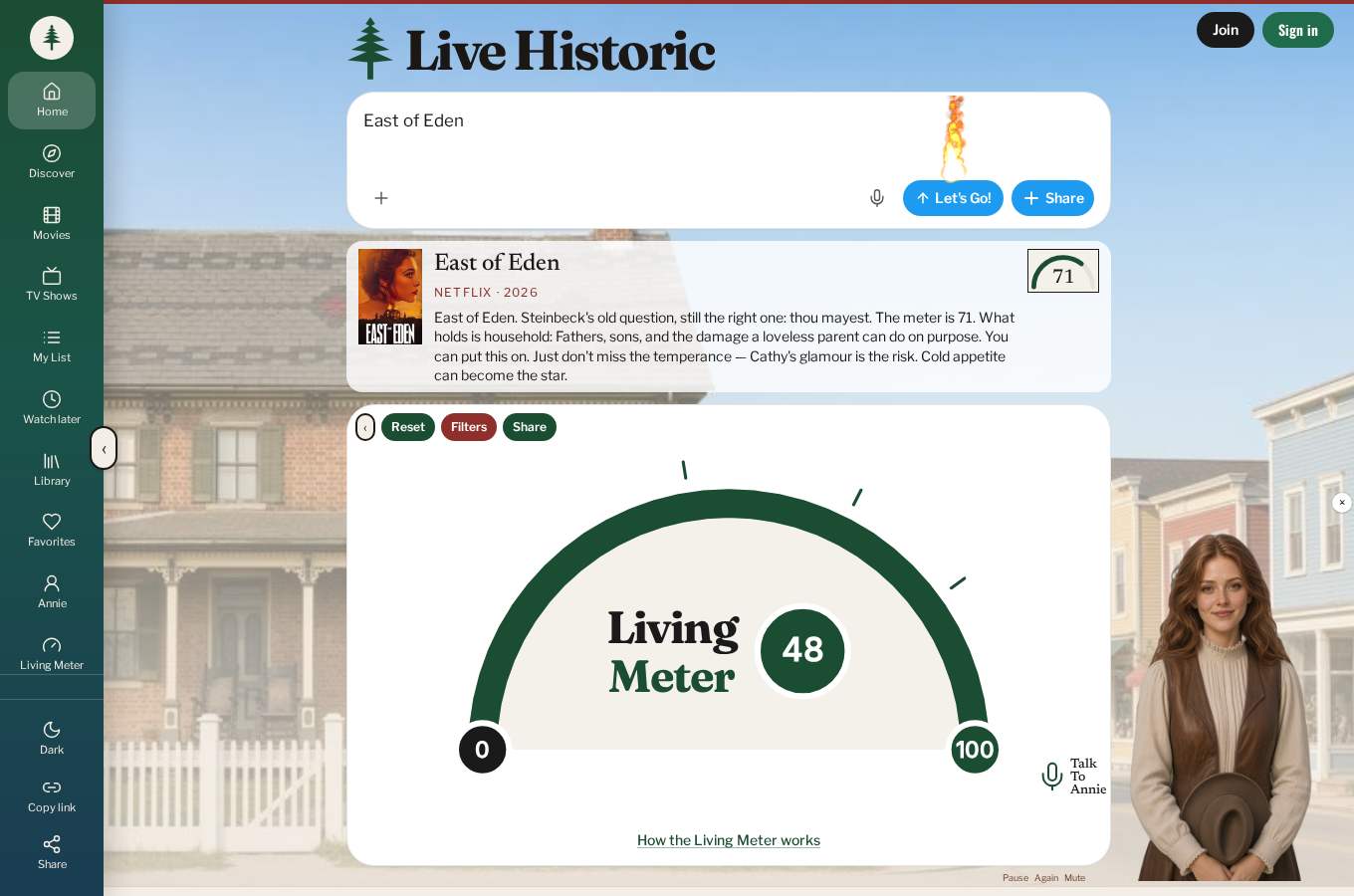
A person types a name. On the first real letter the flames start on Let's Go, which is the cue to take the measure. Matches come back with a score. East of Eden, asked here, is already in the house file, so the number is ready without a wait.

3. Share the review, not the house
The blue Share control opens the sheet: copy the link, send it to a friend, text it, text it with the PDF, download the PDF, or post it. What travels is the picture and the score. The household record does not.
4. The number before the story
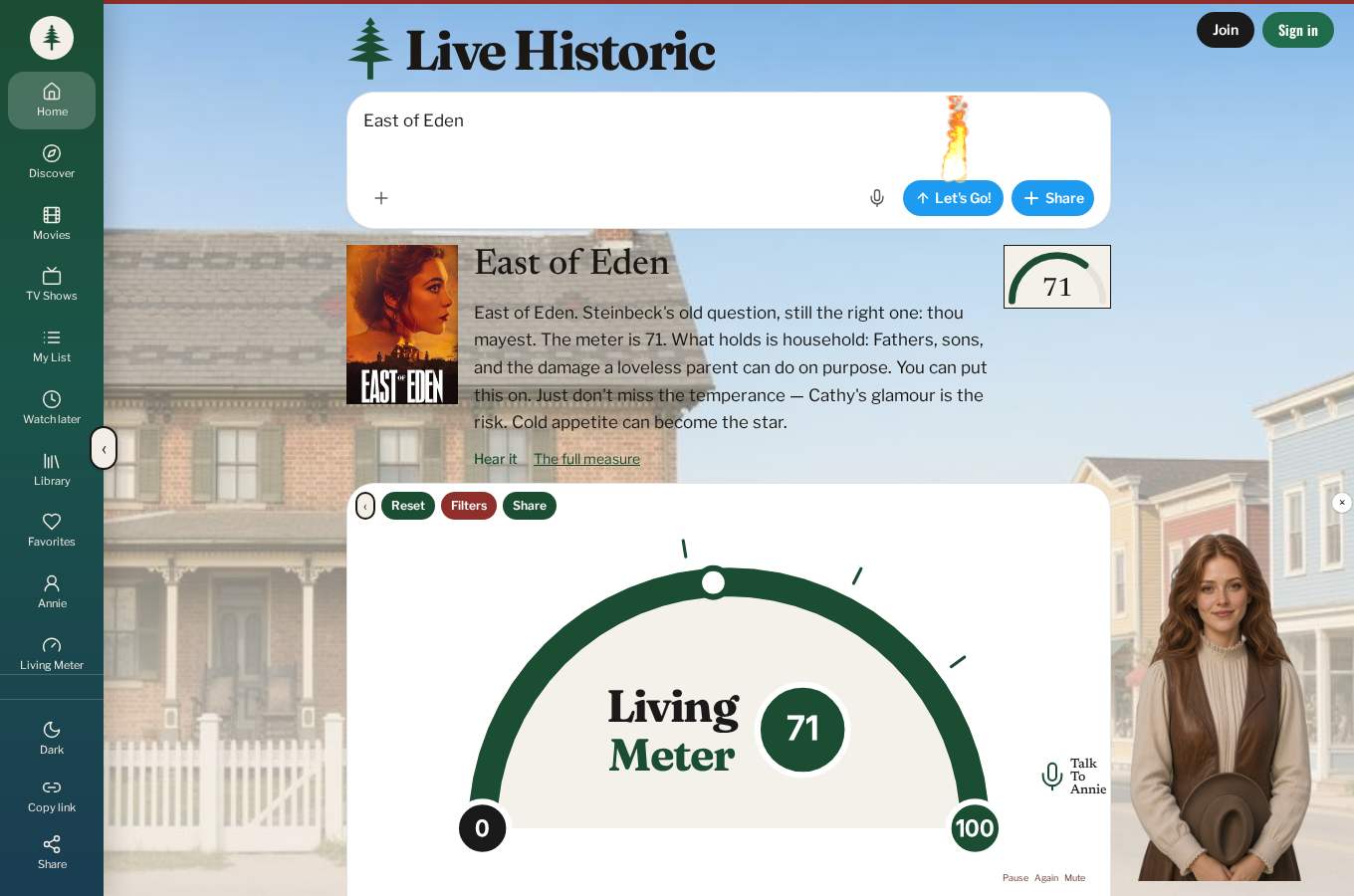
Let's Go, or a tap on the match, puts the judgment on the desk: the name, the Living Meter, and the house's sentence. Hear it reads that sentence aloud. The story has not started.

5. The other plus
The plus on the left of the search is not Share. It takes a file the house brought, shows recent files, or opens Connectors. It does not ask for a streaming password.

6. Connectors, without the password
A shelf is linked by naming the profile and marking what it has been watching. The Living Meter then says where that shelf sits and how to raise it. The password is never the link.

7. The band
Filters set the low end and the high end of the Living Meter. Titles outside that band leave the shelves on this desk. The arc can fold to a line. Reset clears the band.

8. The forty
New releases and the titles people are opening, already scored, highest to lowest. A title is not put in front of the house until it has a number.

9. A child's row
Kiki is five. Her Netflix row is split into what she should sit with and what is too old for tonight. The games under the row are a few minutes of hands, then the phone goes down. They are not the evening.
10. Put this on tonight
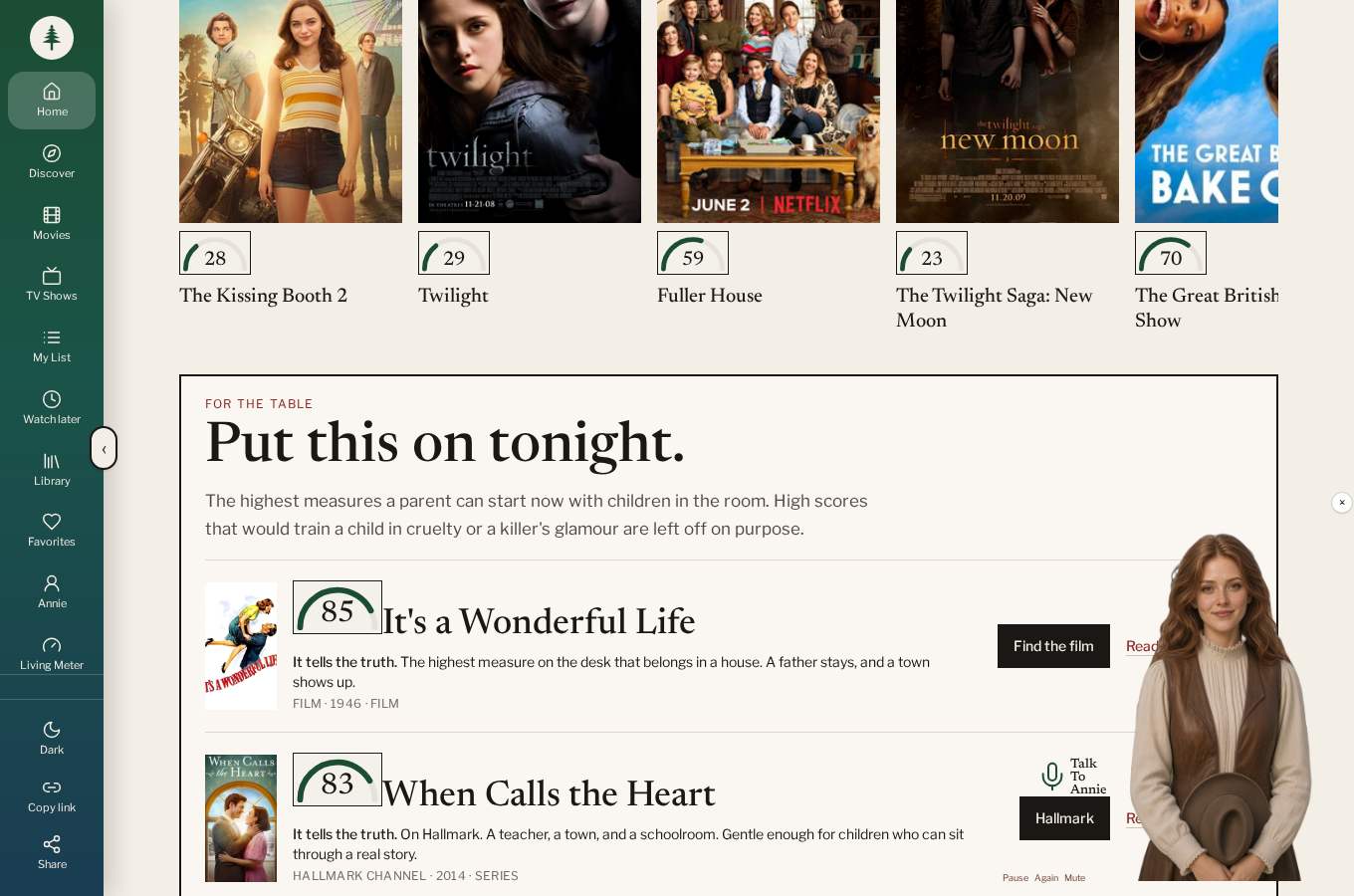
The highest measures a parent can start with children in the room. A high score that would train a child in cruelty, or in a killer's glamour, is left off on purpose.

11. The eight measures
Industry, household, piety, courage, republic, temperance, truth, and stewardship, in a round. Work feeds the house. The house keeps a conscience. What is bound is left to the people after you, and the work begins again.

12. The line under the name
Plant what you will never sit under. Copyright is reserved at the bottom of every page. A review may be shared. The desk itself may not be copied. The registered mark is not on the name.

13. Movies
The films, shelved by the Living Meter. The same band that was set on the home desk still holds.

14. TV shows
Series, scored and sorted the same way as the films. A season is not a different moral question from a picture. It is a longer one.

15. Discover
The highest measures on the desk, for a house that does not yet know the name it wants.

16. A title, opened
East of Eden, opened. The score, the eight virtues, and the judgment sit on the page. Share and the download travel with this title. The house file does not.

17. My List
Titles this house is following. The list lives on the device with the rest of the record.

18. Watch later
Set aside for another evening. Later is not the same as kept. A title can wait without being called worthy.

19. Library
What this house keeps. Kept is a decision, not a view count.

20. Favorites
The ones worth sitting with again. A favorite is still subject to the meter. Affection is not an excuse.

21. Annie
Annie scores a story in the house's voice, and she can sing. A question put to her is not written into the family file.
22. How the Living Meter works
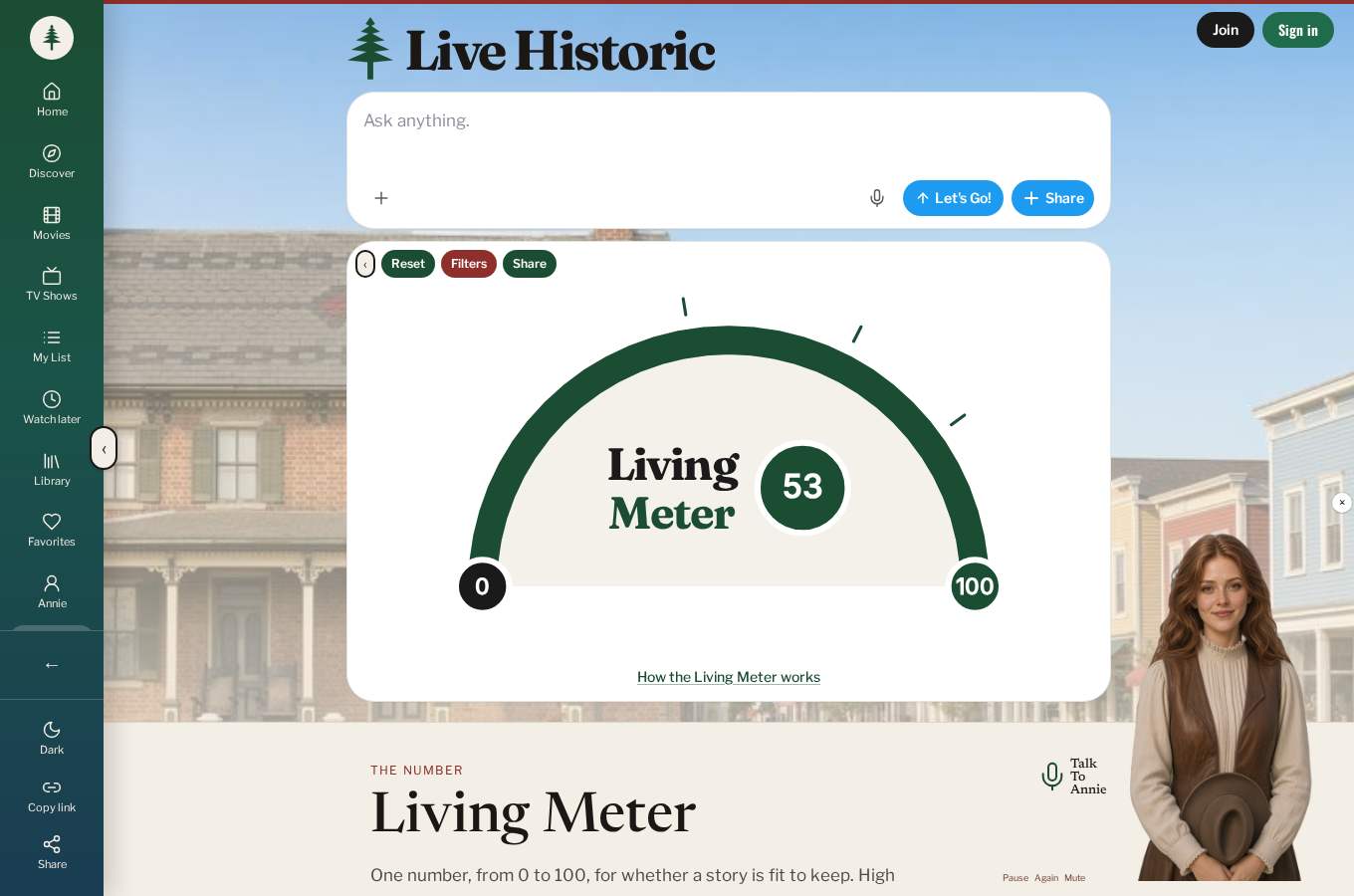
The teaching page for the number. Eight virtues, each from 0 to 10. The meter is their average times ten. It is a judgment, not a diagnosis.

23. Your house
The family desk. The name on the door, and the people the parent has named. Children do not get accounts of their own.

24. The promise
The record stays on this device. It is not sold, rented, or shared. The charity is proposed, not yet recognized, and the page says so. A gift is not deductible until a determination letter.

25. The research
Bandura, Gerbner, Nathanson, and Wood with Neal, named for what they actually found. No percentage is printed that they did not earn. Gerbner's effects are often modest, and the page says so.

26. The plan
What is next, and what is refused. The thirty-day work and the quarter are written here in the same words as this case.
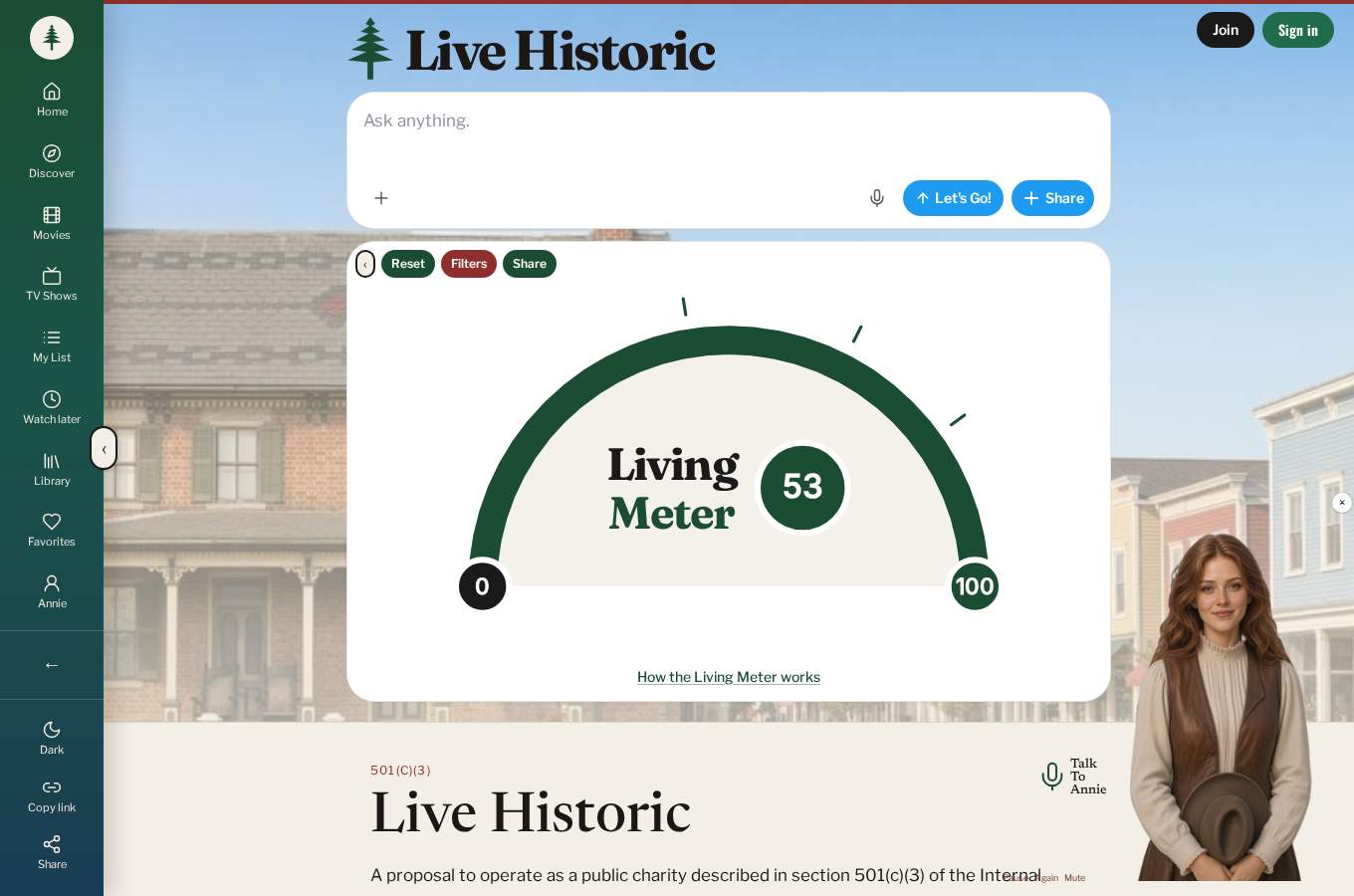
27. The charity proposal
The proposal the board adopts before anyone files. It is not the form, and it is not a determination. The filing, when the board votes, is done only on Pay.gov.

28. The Nation Trail
The shelves by company and by year, the laws that built the screen, and a way to write Congress and the companies. It is a record of the ground, not a campaign.

29. The rubric
How a score is made. Another person can use the same eight questions and come to a number that can be argued with, which is the point.

30. The measures
One minute of film for each virtue, so the words are not left abstract.

31. The House Trail
The wagon game. The house leads. A bad story can end the trip. It is practice in the same choice the evening already requires.
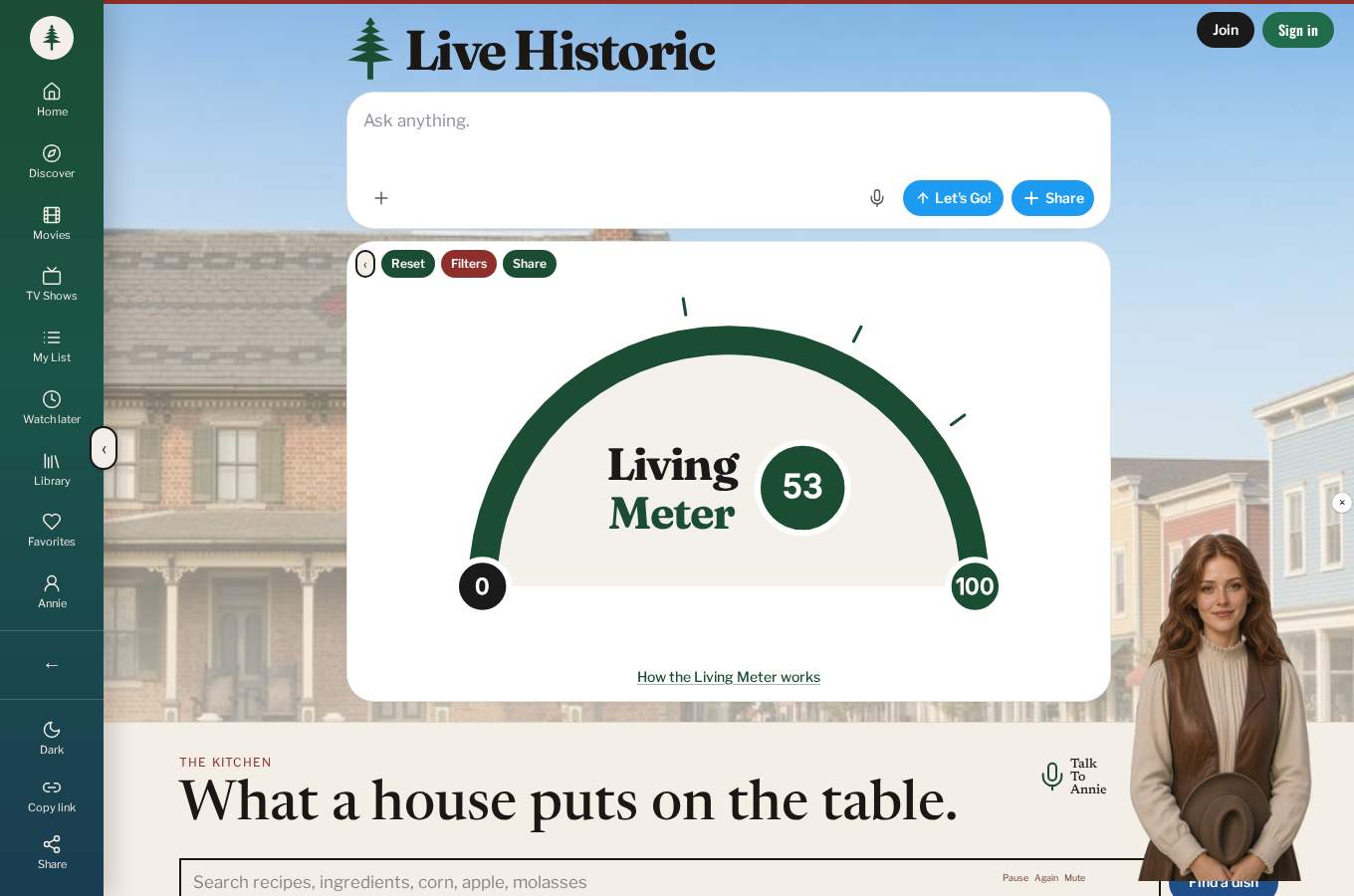
32. The Kitchen
What a house puts on the table. The evening is not only the screen.
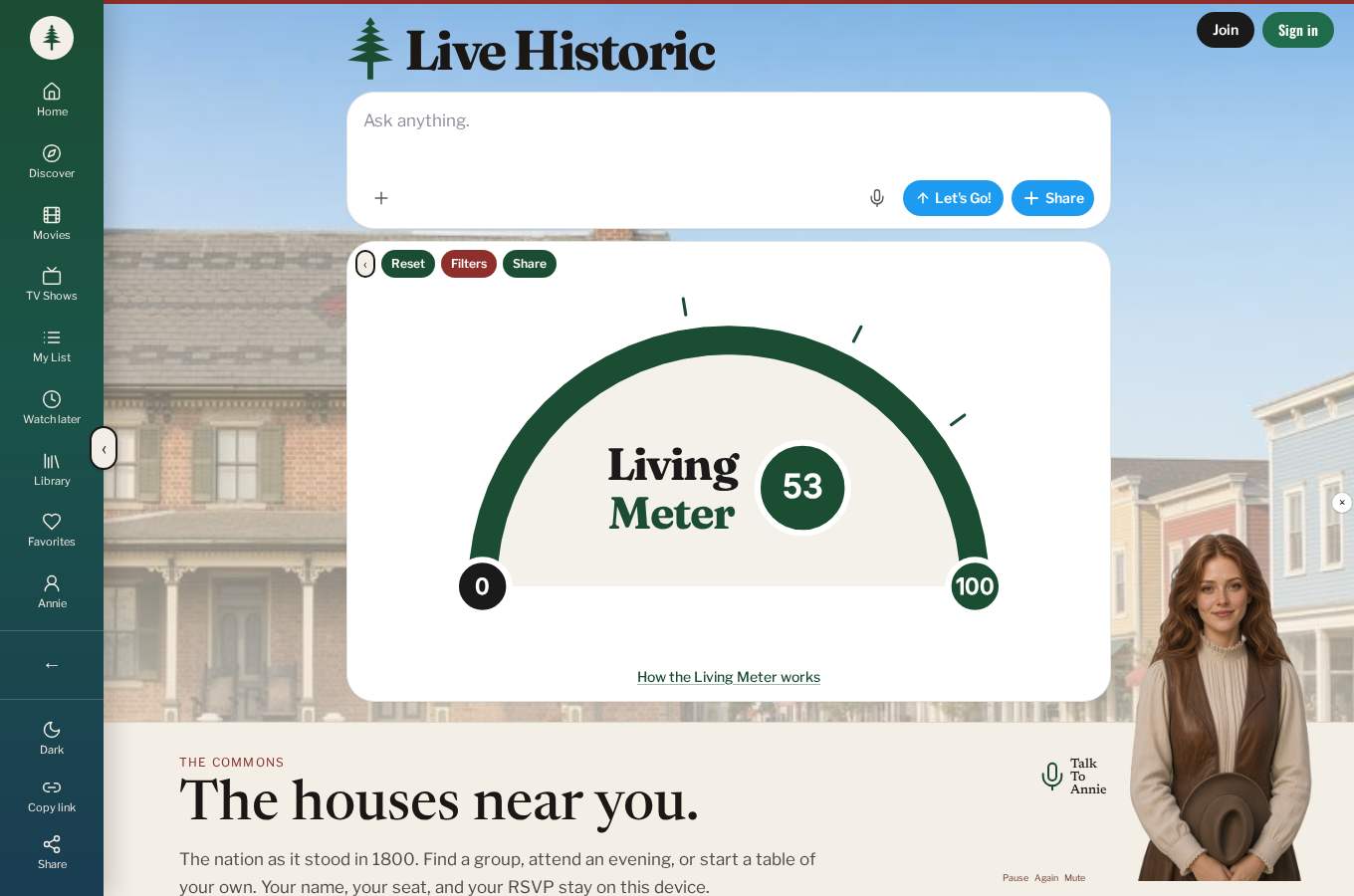
33. The Commons
Groups and evenings near a house. Company is offered. The household record is not the price of admission.

34. The Homestead
A family's own record of the evening: family, frontier, God and country, and the shelves connected without a password.

35. The Commonplace
Measures this house kept on this device. A commonplace is a book you copy into, not a feed someone else fills.

36. Watch
The free films and the scored shelf. Watching is downstream of the number.
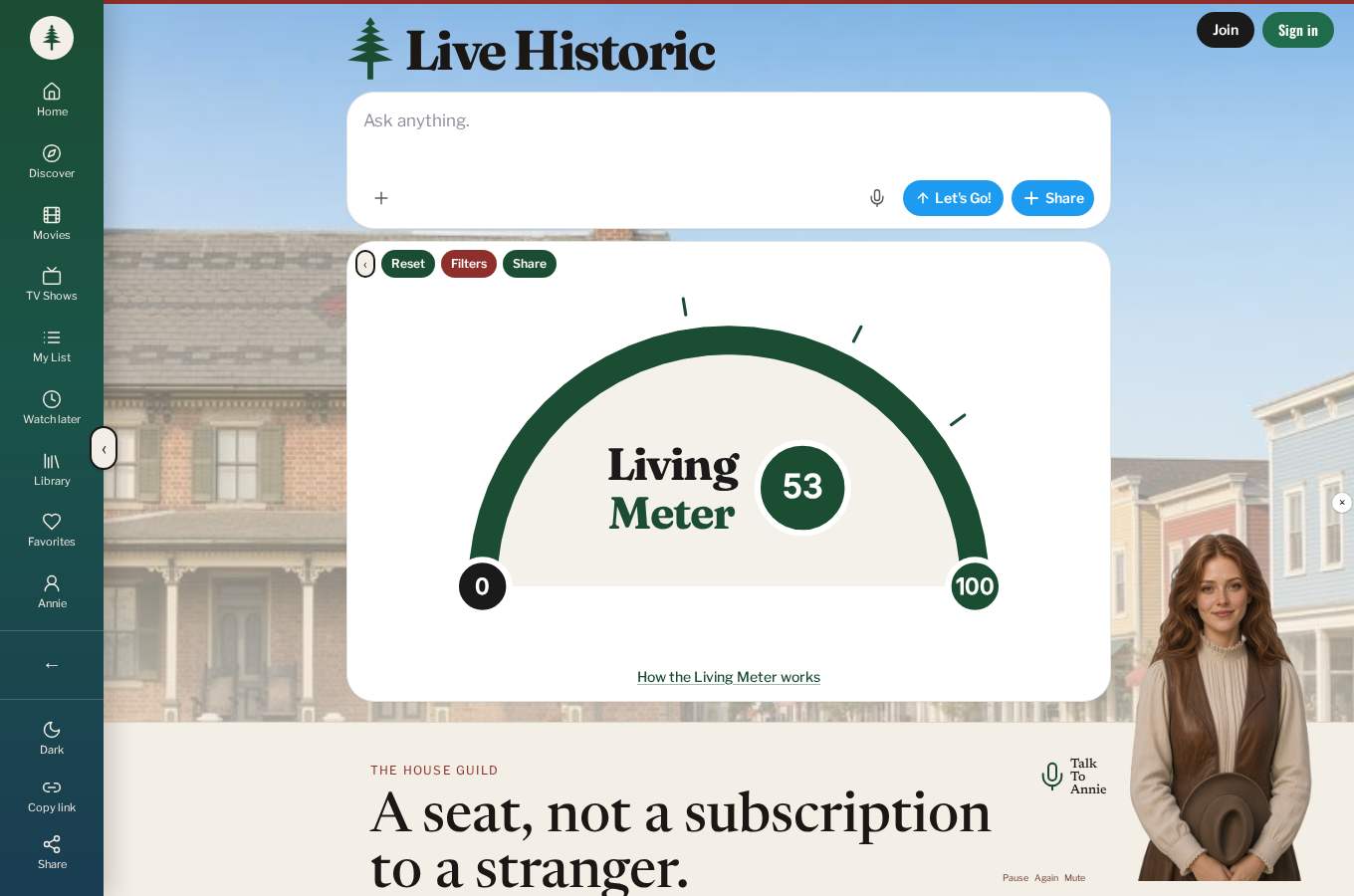
37. The Guild
A seat at the desk, and a vote on the next story. The vote does not rewrite the eight questions.
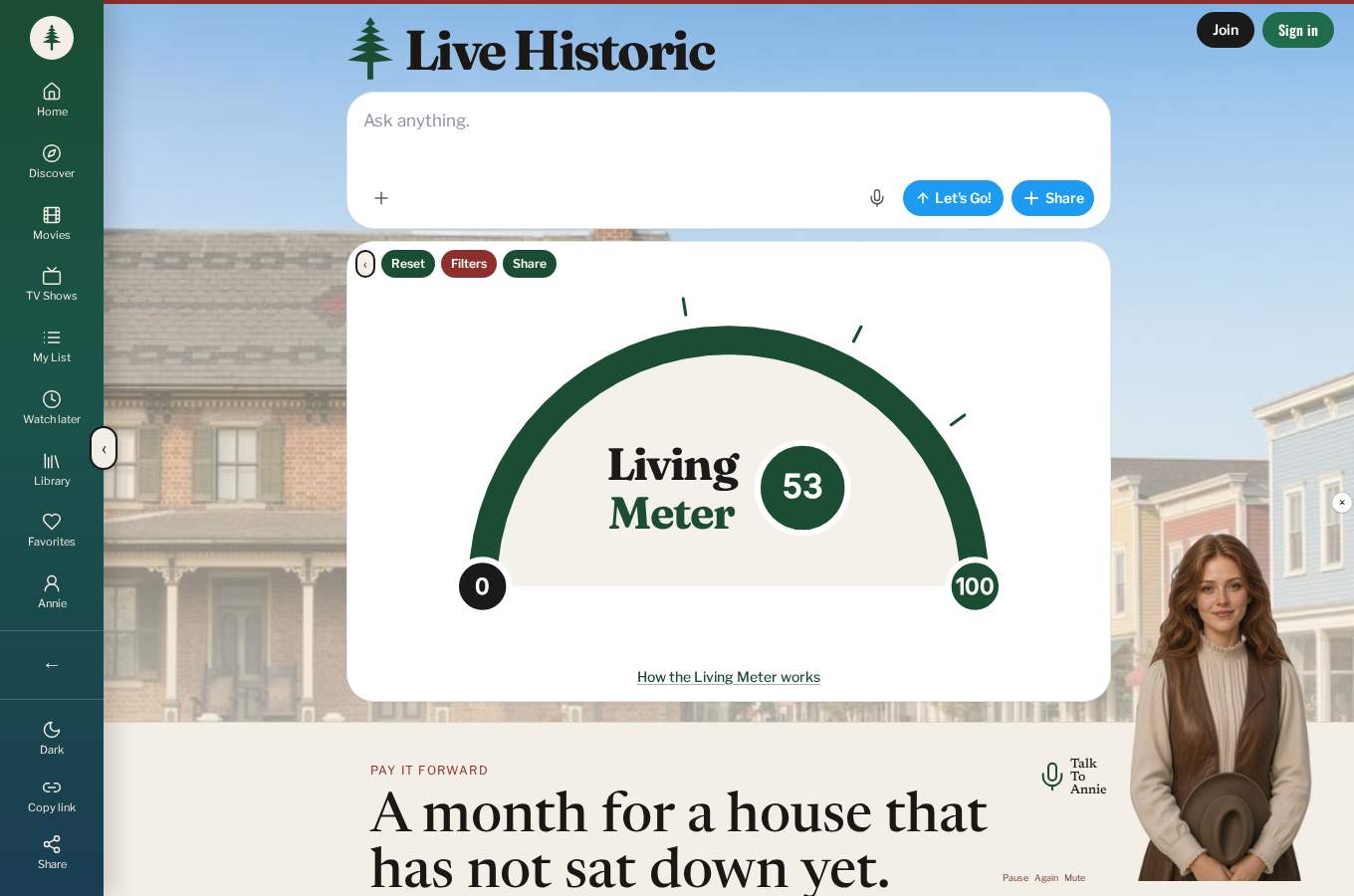
38. Pay it forward
Pass a month to another house. The gift is the desk, not the other family's record.

39. Tickets
Reserve a seat at a house screening. A ticket is for a room, not for a data file.

40. Desk hours
Live hours, and the recording after. What is said in the hour does not become a new virtue.

41. Music
The old public-domain songs. They are here because the house can keep them, not because a catalog rented them.

42. The shop
The films and the mark, for a house that wants a copy of its own. The shop is not an advertising business, and it is not the program.

43. About
What the desk is, in plain terms, and the papers of the house. Not a stock offering, and not a tax determination.
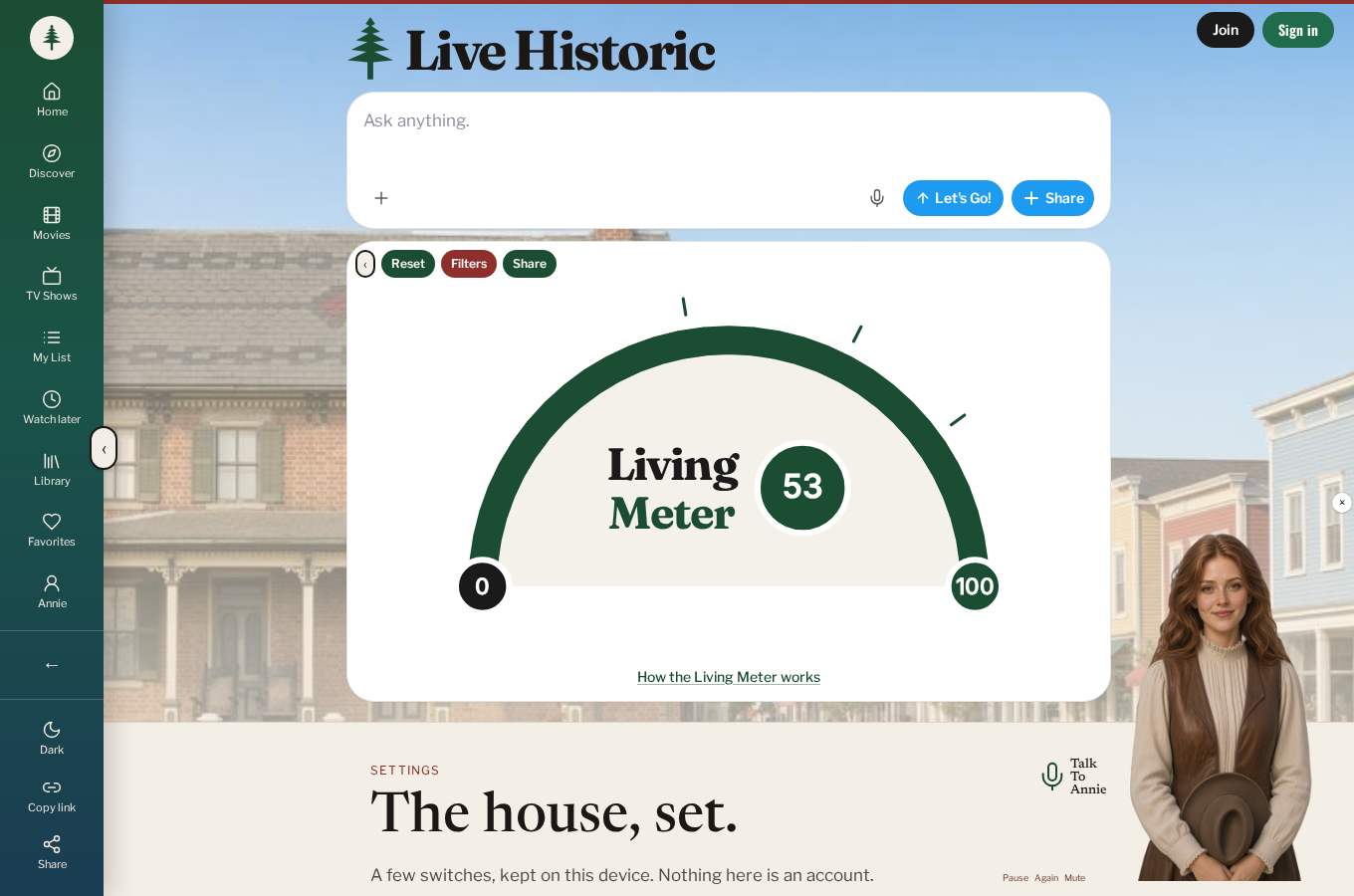
44. Settings
The lamp, the sound, and the name on the door. The settings that matter are the ones a house can change without calling anyone.
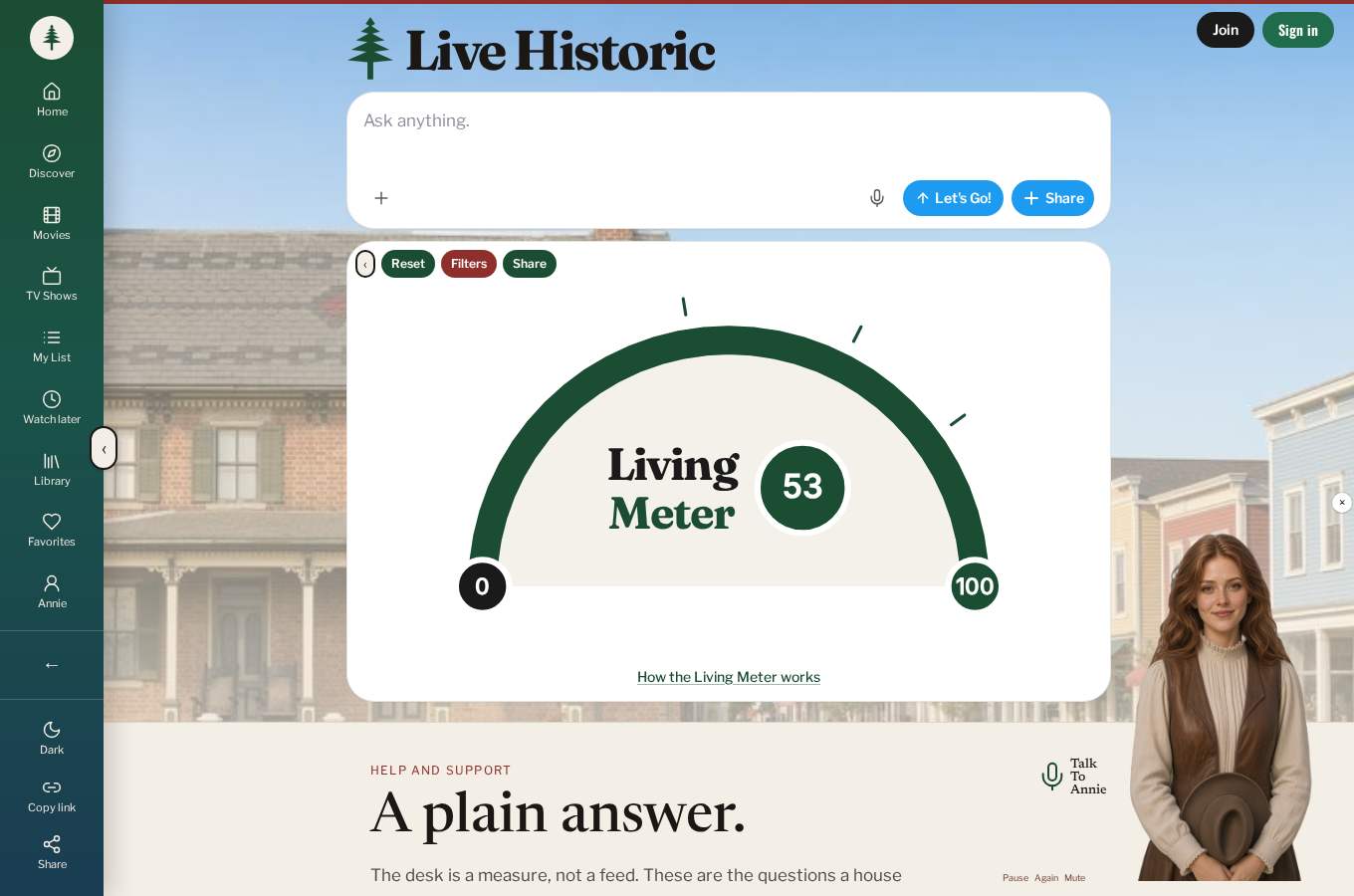
45. Help
How the desk works, written for the person at the screen rather than for the board. The same rules, shorter.
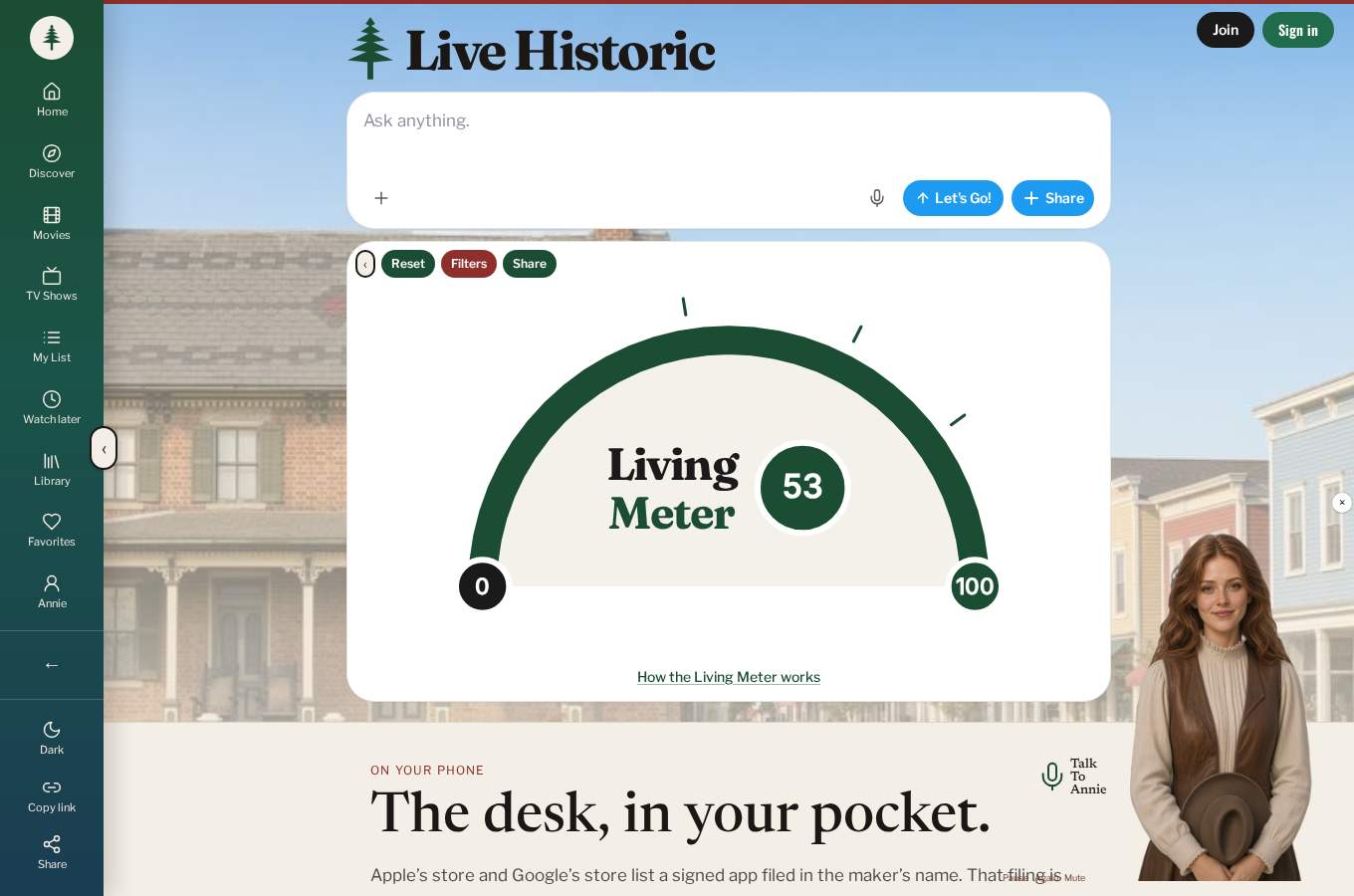
46. Get the desk
Put Live Historic on a phone. The record still stays on that device. A new screen is not a new account for a child.

47. One service, scored
Netflix, opened as a shelf. The dial is the average of the titles we have measured there. The other services sit in the rail the same way. We do not sign in to them.
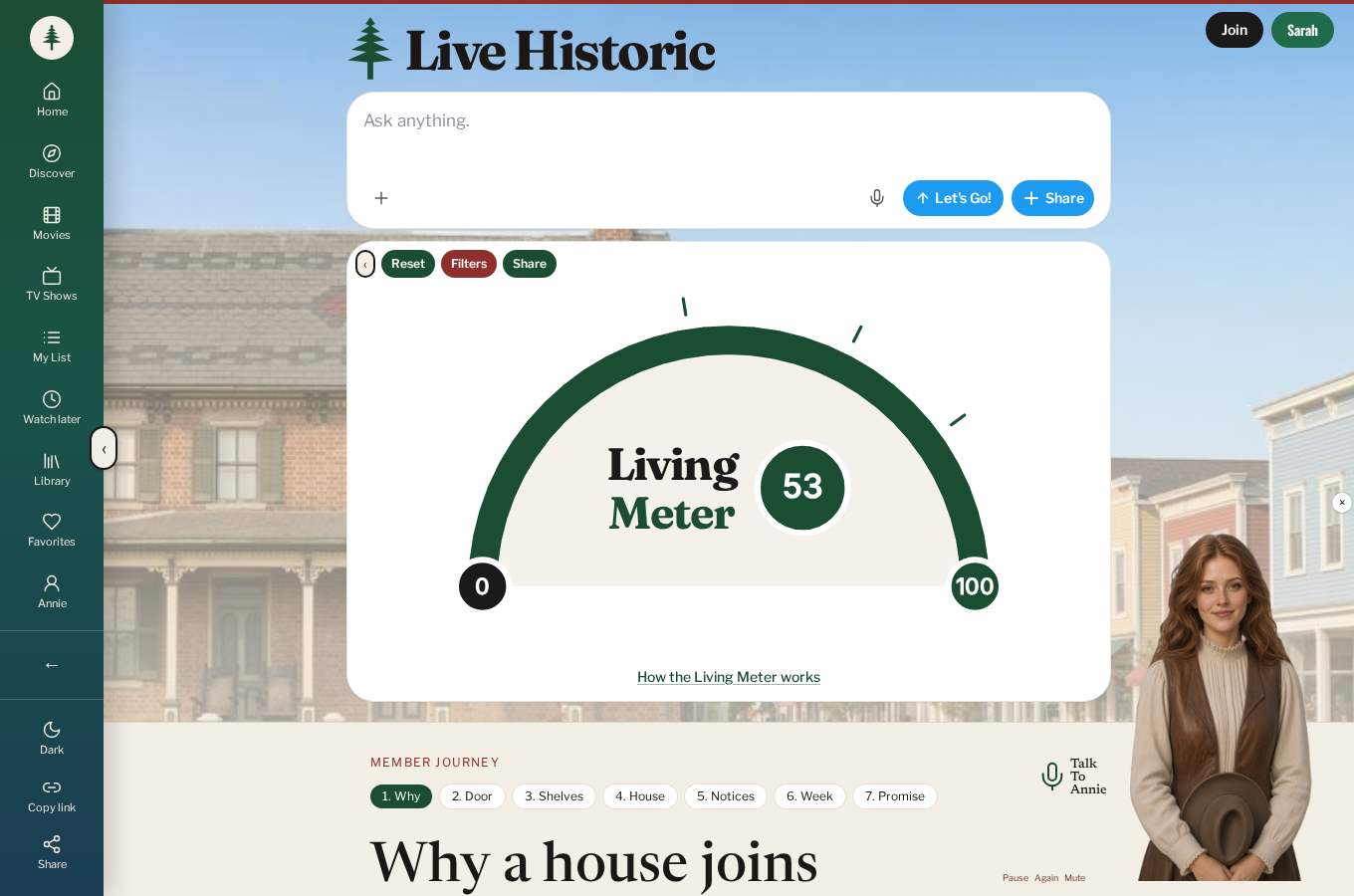
48. Why a house joins
The walk starts with the reasons: one number before the evening, a shelf chosen on purpose, a score for each person, one move for the week, and a record that stays.

49. The door
Join if the house has no name yet. Sign in if it does. The password on this door is the name of the house on this device. It is not a Netflix password, a Hulu password, or any other.

50. Mark the shelf
Pick the service, then the titles that profile has been playing. Scoring can be skipped. The password is not collected. The meter is ready when the marks are.

51. The people
Each name gets the shelf just marked, and a Living Meter of its own. A child is a person in the house, not an account. Age under eighteen is a girl or a boy, not a login.

52. What should find the house
The house can ask to be told when a new release lands on a linked shelf, and to keep a Sunday page. Both stay on the device. Neither is sold as a list.
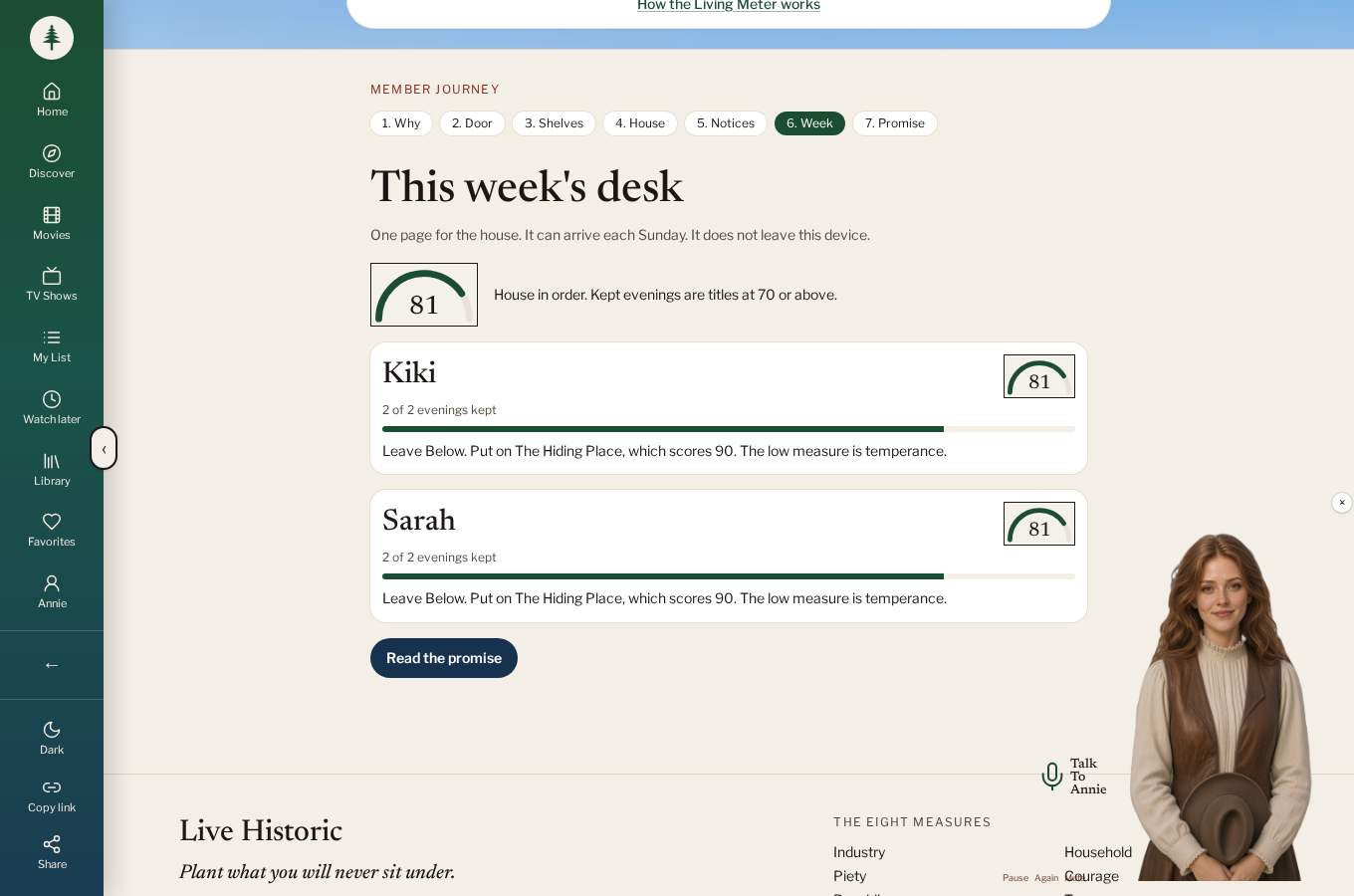
53. This week's desk
One page for the house. Each person has a number, a count of evenings kept at 70 or above, and one swap: leave the lowest title, put on a higher one. The page can arrive on Sunday. It does not leave the device.

54. Erase the house
The last step states the price, which is nothing, and the promise. The record stays on this device. It is not sold or shared. Erase this house, and that record goes. The charity is still a proposal.